HPC Model entries - teacher remarks
The blog post provides a comprehensive guide for teachers implementing the **Holistic Progress Card (HPC)** under the NEP 2020 framework, moving away from traditional grading toward a 360-degree view of student development.
The introduction of the Holistic Progress Card (HPC), as part of the National Education Policy (NEP) 2020, marks a shift from traditional grading to a 360-degree assessment of a child’s development. Writing remarks for these cards requires a balance of empathy, accuracy, and encouragement. Instead of focusing solely on marks, teachers must now capture the essence of a student's cognitive, socio-emotional, and psychomotor skills. Below is a comprehensive guide and a collection of sentence-based remarks categorized by learner profiles to help educators fill out HPCs effectively.
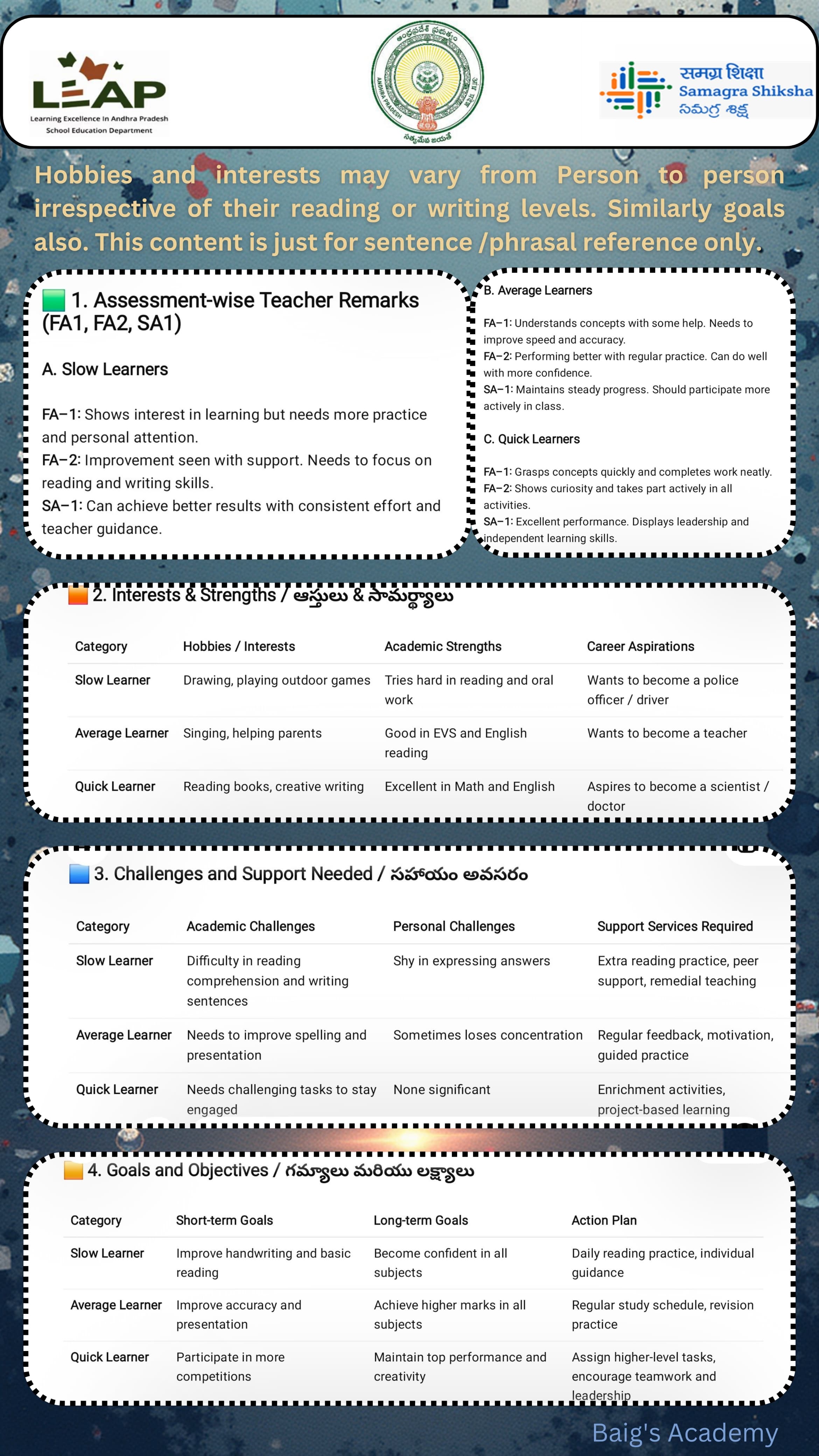
Crafting Assessment-Wise Remarks (FA1, FA2, SA1)
When documenting academic progress across various assessment cycles, it is essential to highlight both the current standing and the trajectory of the student. For students who are currently emerging learners (slow learners), focus on their effort and the specific areas needing intervention. You might write: "The student shows a genuine interest in learning but requires additional practice and personalized attention to master core concepts." As they progress, a remark like, "Visible improvement is seen when support is provided; however, a continued focus on reading and writing skills will yield better results," is highly effective. For those showing steady growth, use: "With consistent effort and teacher guidance, the student is well-positioned to achieve better results in upcoming terms." For developing learners (average learners), the focus should be on refinement. Useful remarks include: "The student understands core concepts well with occasional help but needs to focus on improving speed and accuracy during tasks." To encourage them during mid-term cycles, you could add: "The student is performing significantly better with regular practice and is gaining the confidence needed to tackle complex problems." To maintain momentum, a remark like, "Maintains steady progress throughout the term and is encouraged to participate more actively in classroom discussions," provides a clear path forward. For proficient learners (quick learners), remarks should acknowledge their mastery and leadership. Phrases such as, "Grasps new concepts with remarkable speed and consistently completes work with neatness and precision," or "Displays intense curiosity and takes a lead role in all classroom activities," are appropriate. To push them further, consider: "The student demonstrates excellent performance and displays strong leadership and independent learning skills."
Highlighting Interests, Strengths, and Aspirations
A holistic card is incomplete without recognizing what makes a student unique outside of textbooks. For students with a creative or physical bent, you can note: "The student shows a keen interest in drawing and outdoor games, showing great persistence in oral reading tasks." If a student is helpful and artistically inclined, a remark like, "The student enjoys singing and helping peers, demonstrating a strong foundation in EVS and English reading," works well. For high achievers, focus on their intellectual hobbies: "An avid reader with a talent for creative writing, the student excels in Mathematics and English and aspires toward a career in science." Aligning these strengths with their career aspirations—such as becoming a police officer, teacher, or doctor—makes the card feel personalized and visionary.
Addressing Challenges and Support Requirements
The HPC is a tool for growth, which means challenges must be addressed constructively. For students facing academic hurdles, be specific: "The student currently faces difficulty in reading comprehension and sentence structure; therefore, extra reading practice and remedial teaching are recommended." If the challenge is social, you might write: "While the student is shy in expressing answers, providing a supportive peer environment will help build their confidence." For those who are performing well but may lose focus, use: "The student occasionally loses concentration during long tasks and would benefit from regular feedback and guided practice to stay on track." Even for advanced learners, challenges exist, such as the need for more stimulation: "The student requires more challenging, project-based tasks to stay fully engaged and reach their maximum potential."
Setting Goals and Action Plans
The final component of an effective HPC remark is the "forward-looking" statement. This outlines the short-term and long-term goals. For students building their foundation, use: "Our short-term goal is to improve handwriting and basic reading through daily practice and individual guidance." For steady learners, the focus shifts to excellence: "The student aims to improve accuracy in presentations and is following a regular study schedule to achieve higher marks in all subjects." For top performers, the goal-setting should be ambitious: "The student is encouraged to participate in more competitive events to maintain their top performance and further develop their creative thinking skills."
Summary Table of Remark Snippets for Quick Reference
| Category | Sample Remark Entry (Sentences) |
|---|---|
| Academic Performance | Shows steady progress but needs to focus on accuracy in written work. |
| Socio-Emotional | Displays great empathy by helping others and works well in team settings. |
| Strengths | Possesses excellent analytical skills and shows a natural talent for artistic expression. |
| Growth Area | Requires encouragement to speak up in class to build self-confidence. |
| Action Plan | Daily reading sessions and revision of core concepts will help bridge current gaps. |
By using these descriptive, action-oriented sentences, teachers can transform the Holistic Progress Card from a mere report of the past into a roadmap for a student's future success.